Video: The Ffestiniog Railway
Here’s another great video of Welsh slate railways, this time the Ffestiniog. This video focuses on the equipment used for hauling slate.
Model Railroading and Prototype Research
Here’s another great video of Welsh slate railways, this time the Ffestiniog. This video focuses on the equipment used for hauling slate.
Here’s a very well-done video of the Talyllyn Railway in Wales:
Certainly makes the desire to build a slate railway for my next garden railway even stronger.
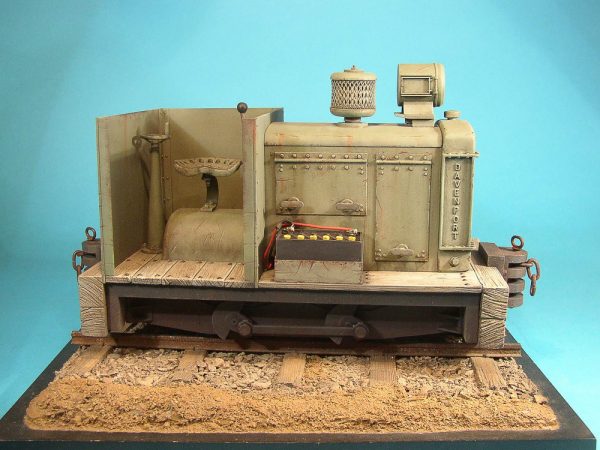
I didn’t jump on buying the Roundhouse Katie back a year ago. Rather today, I made a purchase of the 7/8″ scale Davenport, a collaboration between Model Earth Design and Back to Bay 6 from the UK. I have been following the SE Lounge Forum rather religiously in the last couple of years and have always been impressed by the size and quality of the scale models presented there.
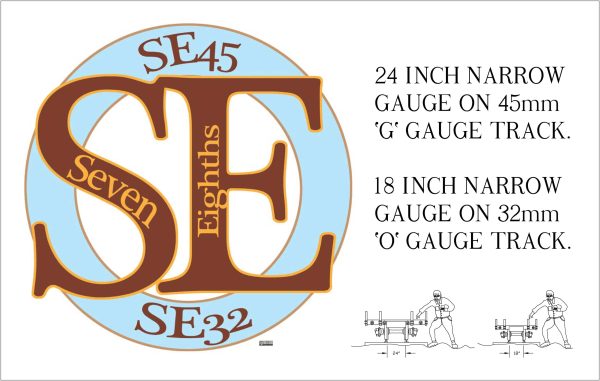
Seven Eighths scale (also written as 7/8″ scale or 1:13.7 scale) uses 45 mm G gauge track to represent 24 inch narrow gauge and so is a very popular scale for people modeling the Maine two-foot railroads (like the Sandy River and Rangeley Lakes, the Bridgton and Saco River, and the Monson Railroads) and the Welsh slate railways (the Ffestiniog , the Corris, and the Talyllyn Railways).
I don’t have too much invested in 1:20.3 rolling stock at the moment and several people have kitbashed Regner locomotives like my Konrad into 7/8″ scale. Here’s one example done by Chris Bird:
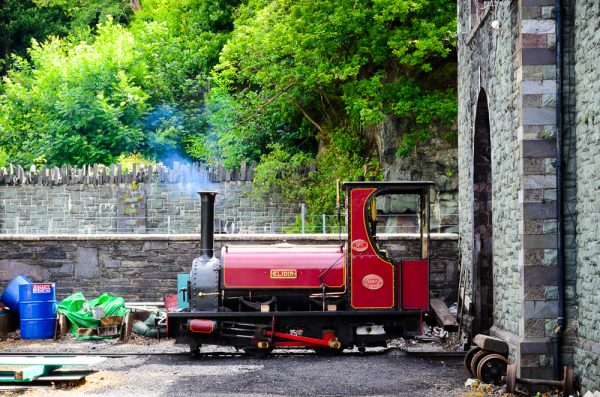
I originally based the concept for the Lost Hollow Railway on a logging theme. However, the more I learn about the narrow gauge slate railways of Wales like the Talyllyn and Ffestiniog Railways, the more I’d like to model them. I rode the Ffestiniog back about 20 years ago but would certainly like to get back to the area again.
We definitely would not have such a large number of engines, rolling stock and even the original right-of-ways had it not been for the people who preserved the Talyllyn Railway in the late 1950’s and early 1960’s. Many of the preservation efforts for narrow gauge steam railways around the world can trace their start to the success of the Talyllyn. While the tone of the following video is a bit condescending, it does show why these “great little trains of Wales” continue to be so successful in the new millennium.
Talyllyn Slate Railway (Wales) circa 1960 [HD]

While surfing around the blog entries on the Model Railroad Hobbyist website, I came across a link to the Upper Canada and Algonquin Railway group, who were building an On30 modular layout based on the Free-Mo standard. Unlike other modular systems like Ntrak, Free-Mo sets some basic requirements, particularly around the module height and the module-to-module interface, and then lets the module designer a great deal of latitude on all other aspects. Prototype modelers have taken to the standard very quickly as it allows them to reproduce real track patterns very accurately. It also allows a lot more creativity removing the “slot-car” look of other older module systems.
I’ve always liked the Free-Mo concept especially now that I don’t have room for a full layout. I could build a couple of modules and participate when I’m around and store the modules away when I’m in the Netherlands. In addition, with Bachmann’s recent releases of On30 locomotives including Shays, Climaxes, 2-6-0’s, 2-8-0’s and 4-4-0’s, there are a lot of possibilities to mimic the Key Valley’s locomotive roster in On30.
The UC&A Railway ran out of steam after a few years but Ron Hurlbut has a webpage documenting its history.

The best source of information concerning the KVR locomotives is the Industrial Locomotive roster in Colin Churcher’s Railway Pages. I’ve cross-referenced the locomotives listed in Churcher’s roster against photographs I’ve collected.
Engine #1 was a 30 ton Shay locomotive (Lima serial # 2679). The history of Engine #1 is summarized in the 1995 Canadian Trackside Guide. It was built in 1913 by Lima as the Dennis Canadian Lumber Co. #1 and apparently worked out of Whitney, Ontario. The Hope Lumber Co. purchased it next and used it until 1928 when it was purchased by the Key Valley Railway, probably to replace the locomotives the KVR lost in a roundhouse fire in 1928. The following photo shows #1 near Lost Channel.

Here is another photo of what I believe is #1. The domes match with the first photo, but the stack has been replaced.

The Key Valley used #1 until 1935 when it was sold to the Standard Chemical Co. of South River. The engine made several other stops until it arrived at the Komoko Railway Museum near London, Ontario. The Railway Museum website has a few photographs of the engine, like this one:

Built in 1910 as Lima serial #2386, this Shay was used by the KVR until it burnt in the roundhouse fire in 1928:

Another photo of #2:

Churcher’s database indicates that the KVR had three Shays in total. He lists this third Shay as having serial #1508 but this has not been confirmed. The following photograph from John Macfie’s collection shows two Shays and a rod engine in the background. Given that the only time the KVR had two Shays on the roster was before 1928, it is likely the photograph was taken then and that the Shays are engines #2 and #4. The rod engine is likely engine #50.

I finally found a picture of #4. Not a great one, especially because it’s on the left side of the engine (the non-interesting side):

Engine #6 is a conventional rod locomotive using the 2-8-0 (Consolidated) wheel pattern. Churcher lists #6 as being built by Baldwin in 1904 as serial #24841. A photograph I have possession of dates the engine as in use in 1922; Churcher listed #6 as starting service on the KVR in 1922. It too was scrapped in 1928 after the same roundhouse fire that claimed #2. Here’s a photo of #6 from John Macfie’s collection:

Another photograph of #6 near Lost Channel:

Engine #39 is a conventional rod locomotive, though it is difficult to make out what type of pattern from the photograph. The photograph dates the engine as in use in 1922. Churcher lists #39 as 4-4-0 wheel pattern built by Rogers in 1883 as serial #3137. It arrived at the KVR in 1917 and like #2 and #6 burned in the roundhouse fire of 1928.
Engine #50 is a conventional rod locomotive originally from the Grand Truck Railway. It appears on the roster in 1917 and was later scrapped. Here’s a photograph of #50, probably at Lost Channel:

And another photo:


Of the major locations on the Key Valley Railway, Lost Channel was the obvious choice to study first.
One of the techniques I used with great success in the past was to use vintage aerial photographs to determine trackage patterns and building locations. For the Key valley Railway, I purchased a set of 1928 aerial photographs for the Lost Channel area. These photos are approximately 1:25000 scale, and can show a fair amount of detail. I’m fairly happy with the technique, although the 1920’s vintage photos are very grainy and lack a lot of detail. I’ve scanned one of the photographs in and annotated it with the important town features I’ve been able to determine so far.

It is clear from this aerial photo that the eastern terminus of the Key Valley Railway was literally the boardway at the sawmill. I had, at first, interpreted the buildings around the sawmill as a tramway structure. However, after closely reading John Macfie’s “Parry Sound Logging Days” book, I learned that the KVR loaded lumber directly from the sorting boardway onto flatcars for transfer to Pakesley, where the major KVR lumber yards were. Given the lack of real estate around the Lost Channel town site, this is hardly surprising that there was no large lumber yard there.
Macfie’s book mentions that there were 12 or 13 spurs running into the boardway. This is confirmed in the following photograph of the sawmill area:
Typical operations would have the Lost Channel yard engine (one of the Shays most probably) spot one flatcar on each spur, parked right up to the boardway floor. Each car was probably assigned to handle a specific grade and dimension of lumber. When the right grade and dimension of board came to a sorter, he would pick it up, turn and stack it on the appropriate flatcar. When a flatcar was filled, the yard engine would swap it with an empty. I assume that when enough cars were filled, a run would be made to Pakesley and an equal number of empties pulled back to Lost Channel.
Lying to the west of the sawmill was the station for Lost Channel. It served both the town site of Lost Channel as well as the local lake steamer, the “Kawigamog”. The lead photograph shows a jumble of buildings wedged between the KVR mainline and the lake itself.
Further to the west where land was easier to clear and develop, the KVR built a small yard to service the sawmill and a wye to turn locomotives.

The two key locations on the KVR were Pakesley and Lost Channel. The major attributes of each village is given below:
Lost Channel
Pakesley
I have also found references to two other important KVR locations between Lost Channel and Pakesley. They are:
Camp Six (about half way between Pakesley and Lost Channel)
Cole’s Siding (just west of Lost Channel)
The Key Valley Railway (KVR) was a standard gauge railway that ran between the villages of Pakesley and Lost Channel in Ontario between 1917 and 1933. It was constructed to transport logs, lumber and people to and from the company’s lumber mill at Lost Channel.
The general location of the Key Valley is given in the following map obtained from Google. The Key Valley was just 12 miles long; the western end met the Canadian Pacific Railway at Pakesley; the eastern end was the company town of Lost Channel.
View The Key Valley Railway in a larger map
The construction of the standard gauge Key Valley Railway was started by the Lauder, Spears and Howland Company in 1914. Before the railway was built, the company used a rugged bush trail to haul lumber to a siding on the Canadian National Railway. Unfortunately, the trail was difficult to maintain and was often impassible. The new railroad, named the Key Valley Railway for the narrow valley in which the roadbed lay, would head directly west of Lost Channel to connect with the Canadian Pacific Railway at Pakesley. Unfortunately, the construction costs of the railway almost bankrupted the Lauder, Spears and Howland Company. In 1917, the Schroeder Mills and Timber Company bought up the financially troubled Lauder company and finished the railway.
In the 1920’s, Lost Channel was a bustling place. The sawmill there was the largest in the area. Within the town site proper, about 300 people lived. Along with the Schroeder Company’s bunkhouses and cookeries for its workers, Lost Channel had stores, a hospital and a school. They even had electrical power.
The railway also connected with the steamship “Kawigamog” which served various villages and resorts on the Pickerel River system. By the mid 1920’s, upwards of 1,200 hunters a year passed over the KVR and onto the “Kawigamog” to arrive the Kawigamog Lodge.
At the other end of the KVR, Pakesley also grew. Here, the Schroeder Company kept its large lumber storage yards from which it supplied the Toronto, Detroit, Chicago and New York markets. In the 1920’s, Pakesley grew to include a post office and a hotel as well as receiving a new CPR station in 1924 to handle the increased passenger traffic to and from Lost Channel.
In 1927, the Schroeder Company, perhaps recognizing that their lumber limits were nearing exhaustion, sold the company to a new company, the Pakesley Lumber Company. In 1930, a devastating fire destroyed the Lost Channel mill, and by 1933, Lost Channel was a ghost town. Pakesley survived into the 1960’s as an important CPR section house, but by 1970, it too had become a ghost town.