Maps: Port Colborne Harbour Railway

In the past, the best way of understanding how the Port Colborne Railway was set up was from their parent company website: Trillium Railway. It had maps, photographs and information about the companies who ship via the PCHR. Unfortunately as of 2021, the website has been rebranded and much of the information has disappeared. I was able to make screen captures of the original maps and here is the lower part of the PCHR circa 2011:

Southern Part of the Port Colborne Harbour Railway

To get a better feel how these are physically located, I’ve created a Google Map with the key parts of the PCHR marked on it:


View Port Colborne Harbour Railway – Trackage Map in a larger map

An excellent resource for photos of the PCHR is Paul Duncan’s Niagara Rails website. Paul has divided his photographs up into two groups: one for the physical plant and one for trains on the physical plant. Here are the direct links for each of the sections of the PCHR (called spurs by the company):

Cayuga Spur: Track
Cayuga Spur: Trains
Covers Feeder East to Feeder West to End of Steel

Canal Spur: Track
Canal Spur: Trains
Covers Feeder West to WH Yard to Forks Jct to Dain and points north

Harbour Spur: Track
Harbour Spur: Trains
Covers Forks Jct to Fielden Jct to Macey Yard

Government Spur: Track
Government Spur: Trains
Covers Fielden Jct to End of Steel (ADM and Southpier)

Videos: Port Colborne Harbour Railway

There are a few videos of the Trillium Railway on the web. The following two videos from 2005 show Trillium Railway Engine #110 working the Canal Spur north of Dain City towards St Catharines. While they are not of the southern part of the PCHR, they do give a good flavour of the line circa 2005. The last two minutes of Part II show #110 crossing the liftbridge on the Canal Spur just east of Forks Junction.

Trillium Railway Part I (2005)

Trillium Railway Part II (2005)

The next two videos show trains shows trains moving strings of covered hoppers from Port Colborne. Unfortunately the video quality is not very high but you can see the types of covered hoppers used in the area. The first video highlights engines #108 and #168 while the second is engine #1859:

Trillium Railway #108 and #168 on Park Avenue, Port Colborne (2008)

Trillium Railway #1859 on Park Avenue, Port Colborne (2011?)

The Trillium Railway


I’m a big fan of Lance Mindheim‘s modern-era modelling. If you haven’t had an opportunity to check out his website featuring his HO scale East Rail and Downtown Spur layouts, please take a few minutes to do so.

I’ve looked at a couple different prototypes over the years for such a layout. The Port Terminal Railroad Association in Houston has several scenes that would fit the bill. The CSX Sarnia Subdivision is another, with the advantage that I actually worked at one of the industries served by the line for several years. In the end, both are a little too large in scope for a small layout.

Then, I found the Trillium Railway in Port Colborne, Ontario. Cobbled together from several railway lines in the Niagara region, the Trillium Railway was tailor-made for the Mindheim approach.

Paul Duncan’s Niagara Rails website contains a wealth of information on the PCHR including its history, its current state and a large number of photographs. Trillium Railway‘s own website contains a great amount of detail on its locomotives, current customers and current trackage. In addition, there are numerous photographs and videos floating around railway photo websites and Youtube. The southern part of the Trillium Railway, also known as the Port Colborne Harbour Railway, has the highest concentration of industries so I will concentrate on documenting it first.

Don’t worry; I haven’t abandoned garden railroading. The Marchlyn Quarry Railway is in the plans to scratch my “narrow gauge live steam” itch, while the Trillium will allow me to explore the “operations prototype-modeling” arena. I currently don’t have room for either, so I’m just collecting information and equipment for both right now.

New (to me) 7/8″ Scale Engine

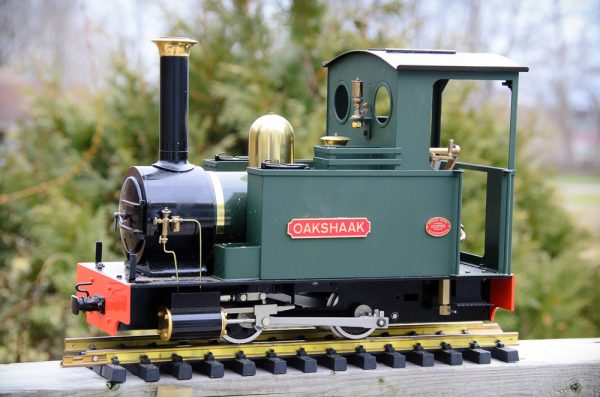
7/8″ Scale Live Steam Engine – Oakshaak

I was fortunate this weekend to surf over to the SE Lounge website and caught sight of a “for sale” announcement for a 7/8″ scale live steam locomotive and some rolling stock. The seller was Canadian and so I made contact and made arrangements to purchase it all. The photo above shows the engine, a Simply 7/8ths Baldrig kit on a Accucraft Eldrig chassis. The previous owner named it “Oakshaak” after the name used by the ancient Mi’kmaq for the New Brunswick town he lives in.

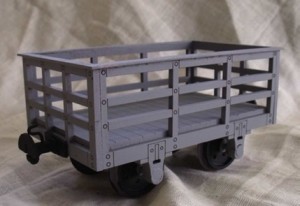
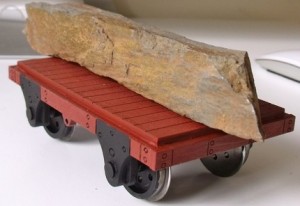
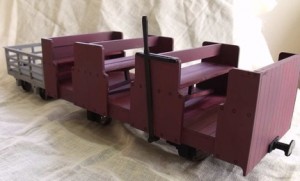
I also got three slate wagons as part of the deal:

Marchlyn Slate Wagons

New Engine, New Scale

Back 2 Bay 6 7/8″ Scale Davenport

I didn’t jump on buying the Roundhouse Katie back a year ago. Rather today, I made a purchase of the 7/8″ scale Davenport made by Back to Bay 6 in the UK. I have been following the SE Lounge Forum rather religiously in the last couple of years and have always been impressed by the size and quality of the scale models presented there. Seven Eighths scale (also can be written as 7/8″ scale or 1:13.7 scale) uses 45 mm G gauge to represent 24 inch narrow gauge gauge and so is a very popular scale for people modeling the Maine two-foot railroads (for example, the Sandy River and Rangeley Lakes , the Bridgton and Saco River, and the Monson Railroads) and the Welsh slate railways (for example, the Ffestiniog , the Corris, and the Talyllyn Railways).

I don’t have too much invested in 1:20.3 rolling stock at the moment and several people have kitbashed Regner locomotives like my Konrad into 7/8″ scale. Here’s one example done by Chris Bird:


The Slate Railways of Wales

I originally based the concept for the Lost Hollow Railway on a logging theme. However, the more I learn about the narrow gauge slate railways of Wales like the Talyllyn and Ffestiniog Railways, the more I’d like to model them. I rode the Ffestiniog back about 20 years ago but would certainly like to get back to the area again.

We definitely would not have such a large number of engines, rolling stock and even the original right-of-ways had it not been for the people who preserved the Talyllyn Railway in the late 1950’s and early 1960’s. Many of the preservation efforts for narrow gauge steam railways around the world can trace their start to the success of the Talyllyn. While the tone of the following video is a bit condescending, it does show why these “great little trains of Wales” continue to be so successful in the new millennium.

Talyllyn Slate Railway (Wales) circa 1960 [HD]