Maps: Port Colborne Harbour Railway
In the past, the best way of understanding how the Port Colborne Railway was set up was from their parent company website: Trillium Railway. It had maps, photographs and information about the companies who ship via the PCHR. Unfortunately as of 2021, the website has been rebranded and much of the information has disappeared. I was able to make screen captures of the original maps and here is the lower part of the PCHR circa 2011:

To get a better feel how these are physically located, I’ve created a Google Map with the key parts of the PCHR marked on it:
View Port Colborne Harbour Railway – Trackage Map in a larger map
An excellent resource for photos of the PCHR is Paul Duncan’s Niagara Rails website. Paul has divided his photographs up into two groups: one for the physical plant and one for trains on the physical plant. Here are the direct links for each of the sections of the PCHR (called spurs by the company):
Cayuga Spur: Track
Cayuga Spur: Trains
Covers Feeder East to Feeder West to End of Steel
Canal Spur: Track
Canal Spur: Trains
Covers Feeder West to WH Yard to Forks Jct to Dain and points north
Harbour Spur: Track
Harbour Spur: Trains
Covers Forks Jct to Fielden Jct to Macey Yard
Government Spur: Track
Government Spur: Trains
Covers Fielden Jct to End of Steel (ADM and Southpier)
Videos: Port Colborne Harbour Railway
There are a few videos of the Trillium Railway on the web. The following two videos from 2005 show Trillium Railway Engine #110 working the Canal Spur north of Dain City towards St Catharines. While they are not of the southern part of the PCHR, they do give a good flavour of the line circa 2005. The last two minutes of Part II show #110 crossing the liftbridge on the Canal Spur just east of Forks Junction.
Trillium Railway Part I (2005)
Trillium Railway Part II (2005)
The next two videos show trains shows trains moving strings of covered hoppers from Port Colborne. Unfortunately the video quality is not very high but you can see the types of covered hoppers used in the area. The first video highlights engines #108 and #168 while the second is engine #1859:
Trillium Railway #108 and #168 on Park Avenue, Port Colborne (2008)
Trillium Railway #1859 on Park Avenue, Port Colborne (2011?)
The Trillium Railway

I’m a big fan of Lance Mindheim‘s modern-era modelling. If you haven’t had an opportunity to check out his website featuring his HO scale East Rail and Downtown Spur layouts, please take a few minutes to do so.
I’ve looked at a couple different prototypes over the years for such a layout. The Port Terminal Railroad Association in Houston has several scenes that would fit the bill. The CSX Sarnia Subdivision is another, with the advantage that I actually worked at one of the industries served by the line for several years. In the end, both are a little too large in scope for a small layout.
Then, I found the Trillium Railway in Port Colborne, Ontario. Cobbled together from several railway lines in the Niagara region, the Trillium Railway was tailor-made for the Mindheim approach.
Paul Duncan’s Niagara Rails website contains a wealth of information on the PCHR including its history, its current state and a large number of photographs. Trillium Railway‘s own website contains a great amount of detail on its locomotives, current customers and current trackage. In addition, there are numerous photographs and videos floating around railway photo websites and Youtube. The southern part of the Trillium Railway, also known as the Port Colborne Harbour Railway, has the highest concentration of industries so I will concentrate on documenting it first.
Don’t worry; I haven’t abandoned garden railroading. The Marchlyn Quarry Railway is in the plans to scratch my “narrow gauge live steam” itch, while the Trillium will allow me to explore the “operations prototype-modeling” arena. I currently don’t have room for either, so I’m just collecting information and equipment for both right now.
Video: The Ffestiniog Railway
Here’s another great video of Welsh slate railways, this time the Ffestiniog. This video focuses on the equipment used for hauling slate.
Video: The Talyllyn Railway
Here’s a very well-done video of the Talyllyn Railway in Wales:
Certainly makes the desire to build a slate railway for my next garden railway even stronger.
The Slate Railways of Wales
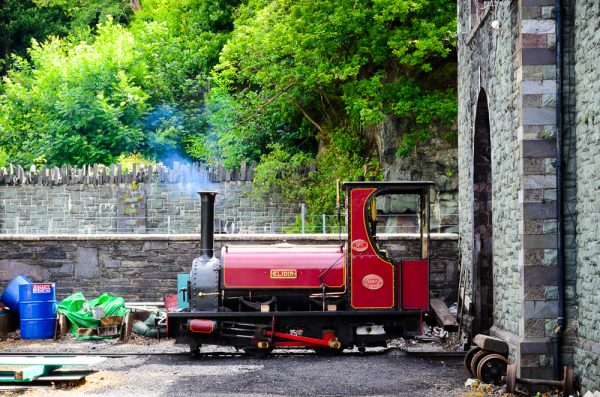
I originally based the concept for the Lost Hollow Railway on a logging theme. However, the more I learn about the narrow gauge slate railways of Wales like the Talyllyn and Ffestiniog Railways, the more I’d like to model them. I rode the Ffestiniog back about 20 years ago but would certainly like to get back to the area again.
We definitely would not have such a large number of engines, rolling stock and even the original right-of-ways had it not been for the people who preserved the Talyllyn Railway in the late 1950’s and early 1960’s. Many of the preservation efforts for narrow gauge steam railways around the world can trace their start to the success of the Talyllyn. While the tone of the following video is a bit condescending, it does show why these “great little trains of Wales” continue to be so successful in the new millennium.
Talyllyn Slate Railway (Wales) circa 1960 [HD]
Key Valley Railway: References

Books
- Brown, Ron, “Ghost Towns of Ontario, Volume 2: Northern Ontario and Cottage Country”, Cannonbooks, Toronto, Ontario, 1983. ISBN 0-9691210-1-6 (v.2)
- Bytown Railway Society Inc., “Canadian Trackside Guide 1995”, Bytown Railway Society Inc., Ottawa, Ontario, 1995.
- Dunn, Craig, “Key Valley Railway: The Railway that Ran to a River and Stopped…”, White Mountain Publications, New Liskeard, Ontario, 2008 ISBN 1-894747-33-X [9781894747332].
- Macfie, John, “Parry Sound Logging Days”, The Boston Mills Press, Erin, Ontario, 1987. ISBN 0-919783-76-7
- Macfie, John, “Parry Sound Old Times”, The Hay Press, Parry Sound, Ontario, 1996. ISBN 0-9694962-1-4
- Mackey, Doug and Paul, “The Fossmill Story: Life in a Railway Lumbering Village on the Edge of Algonquin Park”, Past Forward Heritage, Toronto, Ontario, 1999. ISBN 1-896974-10-4
- Tatley, Richard, “The Steamboat Era in the Muskokas, Volume II – The Golden Years to Present:, The Boston Mills Press, Erin Ontario, 1984. ISBN 0-919783-10-4
Links
- The National Air Photo Library: https://www.nrcan.gc.ca/maps-tools-and-publications/satellite-imagery-and-air-photos/air-photos/22030
- Ontario Ghost Towns: http://www.ghosttownpix.com
- Colin Churcher’s Railway Pages: http://www.railways.incanada.net/
- A Complete Listing of Shay Locomotives: http://www.shaylocomotives.com
Key Valley Railway: Locomotives
The best source of information concerning the KVR locomotives is the Industrial Locomotive roster in Colin Churcher’s Railway Pages. I’ve cross-referenced the locomotives listed in Churcher’s roster against photographs I’ve collected.
Engine #1 – Two Truck Shay
Engine #1 was a 30 ton Shay locomotive (Lima serial # 2679). The history of Engine #1 is summarized in the 1995 Canadian Trackside Guide. It was built in 1913 by Lima as the Dennis Canadian Lumber Co. #1 and apparently worked out of Whitney, Ontario. The Hope Lumber Co. purchased it next and used it until 1928 when it was purchased by the Key Valley Railway, probably to replace the locomotives the KVR lost in a roundhouse fire in 1928. The following photo shows #1 near Lost Channel.

Here is another photo of what I believe is #1. The domes match with the first photo, but the stack has been replaced.

The Key Valley used #1 until 1935 when it was sold to the Standard Chemical Co. of South River. The engine made several other stops until it arrived at the Komoko Railway Museum near London, Ontario. The Railway Museum website has a few photographs of the engine, like this one:

Engine #2 – Two Truck Shay
Built in 1910 as Lima serial #2386, this Shay was used by the KVR until it burnt in the roundhouse fire in 1928:

Another photo of #2:

Engine #4 – Two Truck Shay
Churcher’s database indicates that the KVR had three Shays in total. He lists this third Shay as having serial #1508 but this has not been confirmed. The following photograph from John Macfie’s collection shows two Shays and a rod engine in the background. Given that the only time the KVR had two Shays on the roster was before 1928, it is likely the photograph was taken then and that the Shays are engines #2 and #4. The rod engine is likely engine #50.

I finally found a picture of #4. Not a great one, especially because it’s on the left side of the engine (the non-interesting side):

Engine #6 – 2-8-0 Baldwin
Engine #6 is a conventional rod locomotive using the 2-8-0 (Consolidated) wheel pattern. Churcher lists #6 as being built by Baldwin in 1904 as serial #24841. A photograph I have possession of dates the engine as in use in 1922; Churcher listed #6 as starting service on the KVR in 1922. It too was scrapped in 1928 after the same roundhouse fire that claimed #2. Here’s a photo of #6 from John Macfie’s collection:

Another photograph of #6 near Lost Channel:

Engine #39 – 4-4-0 Rogers
Engine #39 is a conventional rod locomotive, though it is difficult to make out what type of pattern from the photograph. The photograph dates the engine as in use in 1922. Churcher lists #39 as 4-4-0 wheel pattern built by Rogers in 1883 as serial #3137. It arrived at the KVR in 1917 and like #2 and #6 burned in the roundhouse fire of 1928.
Engine #50 – 4-4-0 Manchester
Engine #50 is a conventional rod locomotive originally from the Grand Truck Railway. It appears on the roster in 1917 and was later scrapped. Here’s a photograph of #50, probably at Lost Channel:

And another photo:

Key Valley Railway: Lost Channel

Of the major locations on the Key Valley Railway, Lost Channel was the obvious choice to study first.
One of the techniques I used with great success in the past was to use vintage aerial photographs to determine trackage patterns and building locations. For the Key valley Railway, I purchased a set of 1928 aerial photographs for the Lost Channel area. These photos are approximately 1:25000 scale, and can show a fair amount of detail. I’m fairly happy with the technique, although the 1920’s vintage photos are very grainy and lack a lot of detail. I’ve scanned one of the photographs in and annotated it with the important town features I’ve been able to determine so far.

It is clear from this aerial photo that the eastern terminus of the Key Valley Railway was literally the boardway at the sawmill. I had, at first, interpreted the buildings around the sawmill as a tramway structure. However, after closely reading John Macfie’s “Parry Sound Logging Days” book, I learned that the KVR loaded lumber directly from the sorting boardway onto flatcars for transfer to Pakesley, where the major KVR lumber yards were. Given the lack of real estate around the Lost Channel town site, this is hardly surprising that there was no large lumber yard there.
Macfie’s book mentions that there were 12 or 13 spurs running into the boardway. This is confirmed in the following photograph of the sawmill area:
Typical operations would have the Lost Channel yard engine (one of the Shays most probably) spot one flatcar on each spur, parked right up to the boardway floor. Each car was probably assigned to handle a specific grade and dimension of lumber. When the right grade and dimension of board came to a sorter, he would pick it up, turn and stack it on the appropriate flatcar. When a flatcar was filled, the yard engine would swap it with an empty. I assume that when enough cars were filled, a run would be made to Pakesley and an equal number of empties pulled back to Lost Channel.
Lying to the west of the sawmill was the station for Lost Channel. It served both the town site of Lost Channel as well as the local lake steamer, the “Kawigamog”. The lead photograph shows a jumble of buildings wedged between the KVR mainline and the lake itself.
Further to the west where land was easier to clear and develop, the KVR built a small yard to service the sawmill and a wye to turn locomotives.