Trains @ Station Studios

Model Railroading and Prototype Research

Welcome

without comments

At long last, I’ve decided to move the train pages from my old Frontpage-based system to Wordpress. I’ve consolidated both the model railroading and garden railroading pages into one. Please update your bookmarks if you are arriving from www.stationstudios.ca/pmtco or www.stationstudios.ca/gardenrwy.

I’ve taken the opportunity to update many of the research pages on the prototype Key Valley Railway. You can find all the posts on the KVR here.

If you are looking for posts on my On3/On30 Pakesley Mill and Timber Company, please use this link.

If you are looking for posts on my 1:20.3 scale garden railway, the Lost Hollow Railway, please use this link.

Thanks and enjoy!

Written by Barry Cott

May 21st, 2009 at 2:34 pm

Bookmark and Share

New Engine for the LHR?

without comments


I’m thinking of adding to my live steam collection in the new year. Keeping with the small size of the rolling stock I already have for the Lost Hollow Railway, I was thinking that the Roundhouse Katie would be a good addition. I’m definitely considering the radio control option this time around. Black or green? That is the question.

Written by bjcott

December 5th, 2009 at 9:52 pm

Bookmark and Share

Slate Railways of Wales

without comments

Cabless Talyllyn at Fach Goch on Flickr
My original concept for the Lost Hollow Railway was to base it on a logging theme. However, the more I learn about the narrow gauge slate railways of Wales like the Talyllyn (pictured above) and Ffestiniog Railways, the more I’d like to model them. I rode the Ffestiniog back about 20 years ago but would certainly like to get back to the area again and ride more of them.

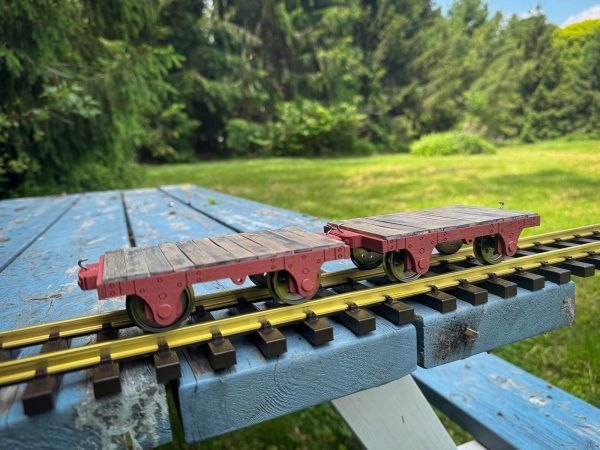
I’ve found some slate wagon drawings on the Internet and they look easy enough to scratchbuild in 1:20.3 scale.

Written by Barry Cott

June 6th, 2009 at 12:24 pm

Bookmark and Share

PM&TCo in Free-MOn30?

without comments

While surfing around the blog entries on the Model Railroad Hobbyist website, I came across a link to the Upper Canada and Algonquin Railway group, who are building an On30 modular layout based on the Free-Mo standard. Unlike other modular systems like Ntrak, Free-Mo sets some basic requirements, particularly around the module height and the module-to-module interface, and then lets the module designer a great deal of latitude on all other aspects. Prototype modelers have taken to the standard very quickly as it allows them to reproduce real track patterns very accurately. It also allows a lot more creativity removing the “slot-car” look of other older module systems.

I’ve always liked the Free-Mo concept especially now that I don’t have room for a full layout. I could build a couple of modules and participate when I’m around and store the modules away when I’m in the Netherlands. In addition, with Bachmann’s recent releases of On30 locomotives including Shays, Climaxes, 2-6-0’s, 2-8-0’s and 4-4-0’s, there are a lot of possibilities to mimic the Key Valley’s locomotive roster in On30.

I’ve been in touch with the UC&A group and am looking to add the Pakesley Mill and Timber Company to the consortium of companies making up the UC&A.

Written by Barry Cott

May 30th, 2009 at 9:07 am

Bookmark and Share

Key Valley Railway: References

without comments

Books

  • Brown, Ron, “Ghost Towns of Ontario, Volume 2: Northern Ontario and Cottage Country”, Cannonbooks, Toronto, Ontario, 1983. ISBN 0-9691210-1-6 (v.2)
  • Bytown Railway Society Inc., “Canadian Trackside Guide 1995″, Bytown Railway Society Inc., Ottawa, Ontario, 1995.
  • Dunn, Craig, “Key Valley Railway: The Railway that Ran to a River and Stopped…”, White Mountain Publications, New Liskeard, Ontario, 2008 ISBN 1-894747-33-X [9781894747332].
  • Macfie, John, “Parry Sound Logging Days”, The Boston Mills Press, Erin, Ontario, 1987. ISBN 0-919783-76-7
  • Macfie, John, “Parry Sound Old Times”, The Hay Press, Parry Sound, Ontario, 1996. ISBN 0-9694962-1-4
  • Mackey, Doug and Paul, “The Fossmill Story: Life in a Railway Lumbering Village on the Edge of Algonquin Park”, Past Forward Heritage, Toronto, Ontario, 1999. ISBN 1-896974-10-4
  • Tatley, Richard, “The Steamboat Era in the Muskokas, Volume II - The Golden Years to Present:, The Boston Mills Press, Erin Ontario, 1984. ISBN 0-919783-10-4

Links

Written by Barry Cott

February 25th, 2009 at 7:52 am

Bookmark and Share

Posted in Key Valley Railway

Key Valley Railway: Locomotives

without comments

The best source of information concerning the KVR locomotives is the Industrial Locomotive roster in Colin Churcher’s Railway Pages. I’ve cross-referenced the locomotives listed in Churcher’s roster against photographs I’ve collected.

Engine #1 - Two Truck Shay

Engine #1 was a 30 ton Shay locomotive (Lima serial # 2679). The history of Engine #1 is summarized in the 1995 Canadian Trackside Guide. It was built in 1913 by Lima as the Dennis Canadian Lumber Co. #1 and apparently worked out of Whitney, Ontario. The Hope Lumber Co. purchased it next and used it until 1928 when it was purchased by the Key Valley Railway, probably to replace the locomotives the KVR lost in a roundhouse fire in 1928. The following photo shows #1 near Lost Channel.

KVR Shay

The Key Valley used #1 until 1935 when it was sold to the Standard Chemical Co. of South River. The engine made several other stops until it arrived at the Komoko Railway Museum near London, Ontario. The Railway Museum website has a large set of photographs of the engine in service and during their rebuilding efforts.

Engine #2 - Two Truck Shay

Built in 1910 as Lima serial #2386, this Shay was used by the KVR until it burnt in the roundhouse fire in 1928.

Engine #4 - Two Truck Shay

Churcher’s database indicates that the KVR had three Shays in total. He lists this third Shay as having serial #1518 but this has not been confirmed. The following photograph from John Macfie’s collection shows two Shays and a rod engine in the background. Given that the only time the KVR had two Shays on the roster was before 1928, it is likely the photograph was taken then and that the Shays are engines #2 and #4. The rod engine is likely engine #50.

Key Valley Railway Tracks at the Lost Channel Sawmill

Engine #6 - 2-8-0 Baldwin

Engine #6 is a conventional rod locomotive using the 2-8-0 (Consolidated) wheel pattern. Churcher lists #6 as being built by Baldwin in 1904 as serial #24841. A photograph I have possession of dates the engine as in use in 1922; Churcher listed #6 as starting service on the KVR in 1922. It too was scrapped in 1928 after the same roundhouse fire that claimed #2. Here’s a photo of #6 from John Macfie’s collection:

KVR Engine No 6

Another photograph of #6 near Lost Channel:

KVR Engine

Engine #39 - 4-4-0 Rogers

Engine #39 is a conventional rod locomotive, though it is difficult to make out what type of pattern from the photograph. The photograph dates the engine as in use in 1922. Churcher lists #39 as 4-4-0 wheel pattern built by Rogers in 1883 as serial #3137. It arrived at the KVR in 1917 and like #2 and #6 burned in the roundhouse fire of 1928.

Engine #50 - 4-4-0 Manchester

Engine #50 is a conventional rod locomotive originally from the Grand Truck Railway. It appears on the roster in 1917 and was later scrapped. Here’s a photograph of #50, probably at Lost Channel:

KVR Engine No. 50

Written by Barry Cott

February 24th, 2009 at 7:32 am

Bookmark and Share

Posted in Key Valley Railway

Key Valley Railway: Lost Channel

without comments

Of the major locations on the Key Valley Railway, Lost Channel was the obvious choice to study first.

One of the techniques I used with great success in the past was to use vintage aerial photographs to determine trackage patterns and building locations. For the Key valley Railway, I purchased a set of 1928 aerial photographs for the Lost Channel area. These photos are approximately 1:25000 scale, and can show a fair amount of detail. I’m fairly happy with the technique, although the 1920’s vintage photos are very grainy and lack a lot of detail. I’ve scanned one of the photographs in and annotated it with the important town features I’ve been able to determine so far.

Lost Channel Actual

It is clear from this aerial photo that the eastern terminus of the Key Valley Railway was literally the boardway at the sawmill. I had, at first, interpreted the buildings around the sawmill as a tramway structure. However, after closely reading John Macfie’s “Parry Sound Logging Days” book, I learned that the KVR loaded lumber directly from the sorting boardway onto flatcars for transfer to Pakesley, where the major KVR lumber yards were. Given the lack of real estate around the Lost Channel town site, this is hardly surprising that there was no large lumber yard there.

Macfie’s book mentions that there were 12 or 13 spurs running into the boardway. This is confirmed in the following photograph of the sawmill area:

Key Valley Railway Tracks at the Lost Channel Sawmill

Typical operations would have the Lost Channel yard engine (one of the Shays most probably) spot one flatcar on each spur, parked right up to the boardway floor. Each car was probably assigned to handle a specific grade and dimension of lumber. When the right grade and dimension of board came to a sorter, he would pick it up, turn and stack it on the appropriate flatcar. When a flatcar was filled, the yard engine would swap it with an empty. I assume that when enough cars were filled, a run would be made to Pakesley and an equal number of empties pulled back to Lost Channel.

Lying to the west of the sawmill was the station for Lost Channel. It served both the town site of Lost Channel as well as the local lake steamer, the “Kawigamog”. The following photograph shows a jumble of buildings wedged between the KVR mainline and the lake itself:

Key Valley Railway Station and Dock at Lost Channel

Further to the west where land was easier to clear and develop, the KVR built a small yard to service the sawmill and a wye to turn locomotives.

Written by Barry Cott

February 23rd, 2009 at 7:49 pm

Bookmark and Share

Posted in Key Valley Railway

Key Valley Railway: Locations

without comments

The two key locations on the KVR were, of course, Pakesley and Lost Channel. The major attributes of each village is given below:

Lost Channel

  • the company sawmill;
  • the company town site;
  • a station serving both the townsite and the local lake steamer;
  • a wye for turning locomotives;
  • a small yard to support the local trackage.

Pakesley

  • the interchange with the Canadian Pacific Railway;
  • the main lumber storage yards;
  • a station on the Canadina Pacific for passengers transferring to and from the KVR;
  • a wye for turning locomotives;
  • the likely location of the KVR engine facilities.

I have also found references to two other important KVR locations between Lost Channel and Pakesley. They are:

Camp Six (about half way between Pakesley and Lost Channel)

  • one of the company’s logging camps, with a road connecting it to other camps lying to the north;
  • a log loading area;
  • possibly a passing siding.

Cole’s Siding (just west of Lost Channel)

  • a connection to a short branch where log loading occurred;
  • possibly a passing siding;
  • possibly a spur to a sand/gravel quarry.

Written by Barry Cott

February 22nd, 2009 at 7:47 pm

Bookmark and Share

Posted in Key Valley Railway

Key Valley Railway: History

without comments

The Key Valley Railway (KVR) was a standard gauge railway that ran between the villages of Pakesley and Lost Channel in Ontario between 1917 and 1933. It was constructed to transport logs, lumber and people to and from the company’s lumber mill at Lost Channel.

The general location of the Key Valley is given in the following map obtained from Google. The Key Valley was just 12 miles long; the western end met the Canadian Pacific Railway at Pakesley; the eastern end was the company town of Lost Channel.


View The Key Valley Railway in a larger map

The construction of the standard gauge Key Valley Railway was started by the Lauder, Spears and Howland Company in 1914. Before the railway was built, the company used a rugged bush trail to haul lumber to a siding on the Canadian National Railway. Unfortunately, the trail was difficult to maintain and was often impassible. The new railroad, named the Key Valley Railway for the narrow valley in which the roadbed lay, would head directly west of Lost Channel to connect with the Canadian Pacific Railway at Pakesley. Unfortunately, the construction costs of the railway almost bankrupted the Lauder, Spears and Howland Company. In 1917, the Schroeder Mills and Timber Company bought up the financially troubled Lauder company and finished the railway.

In the 1920’s, Lost Channel was a bustling place. The sawmill there was the largest in the area. Within the town site proper, about 300 people lived. Along with the Schroeder Company’s bunkhouses and cookeries for its workers, Lost Channel had stores, a hospital and a school. They even had electrical power.

The railway also connected with the steamship “Kawigamog” which served various villages and resorts on the Pickerel River system. By the mid 1920’s, upwards of 1,200 hunters a year passed over the KVR and onto the “Kawigamog” to arrive the Kawigamog Lodge.

At the other end of the KVR, Pakesley also grew. Here, the Schroeder Company kept its large lumber storage yards from which it supplied the Toronto, Detroit, Chicago and New York markets. In the 1920’s, Pakesley grew to include a post office and a hotel as well as receiving a new CPR station in 1924 to handle the increased passenger traffic to and from Lost Channel.

In 1927, the Schroeder Company, perhaps recognizing that their lumber limits were nearing exhaustion, sold the company to a new company, the Pakesley Lumber Company. In 1930, a devastating fire destroyed the Lost Channel mill, and by 1933, Lost Channel was a ghost town. Pakesley survived into the 1960’s as an important CPR section house, but by 1970, it too had become a ghost town.

Written by Barry Cott

February 21st, 2009 at 7:37 pm

Bookmark and Share

Posted in Key Valley Railway

‘08 on the Lost Hollow Railway

without comments

Compiled by the LHR General Manager, B.J. Cott.

March 8: The first version of the Lost Hollow Railway has been decommissioned due to a job-related move. I still hope to make it out to the various steamups in the southeast Texas area over the next few months and rebuild the LHR at our next place.

I learned many things on the first version of the Lost Hollow:

  1. The hardiplank roadbed system I used worked great for the soil here in Houston. Everything was rock solid and I had no problems with track alignment. Thanks to John Frank for his advice in this area. Details on the hardiplank roadbed system are available here.
  2. I put ground zero too low. I should have raised it about 1-2″ more than I did. I had some problems with the lowest level train getting filled in with earth from higher points of the layout.
  3. I should have used a retaining wall between the the upper and lower mainlines. Through the center section of the layout, the upper and lower mainlines were separated by 3 inches in vertical height and about 9-12 inches horizontally. I had difficulties keeping the earth on the upper mainline from running down onto the lower mainline. A retaining wall or crib system would have helped.
  4. Switches were mostly unnecessary for this live steam layout. The small radius Aristocraft ones that I used were probably too small anyways.
  5. We should have put down a weed/plant barrier in the loop sections of the layout to get a handle on the weeds. The layout got very weedy in the last couple of years.

Written by Barry Cott

December 31st, 2008 at 7:00 pm

Bookmark and Share